
Wine Tasting Adventure
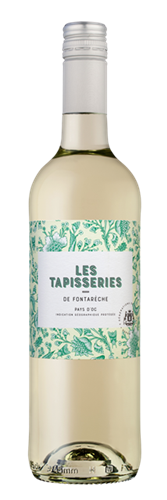
2024 Domaines de Lamy, Tapisserie Blanc IGP Pays d'Oc - Liberty
- Regular price
- £9.99 GBP
- Regular price
-
- Sale price
- £9.99 GBP
- Unit price
- per
Couldn't load pickup availability
One of the most historic estates in the Languedoc, Château Fontarèche has been in the Mignard family since 1642 and is today owned by Jacques De Lamy. Winemaker Vincent Dubernet is the second generation of his family to make these wines, having taken over from his father as a consultant winemaker.
Château Fontarèche comprises 160 hectares of sustainably farmed vines, surrounded by 10 hectares of forest. These vineyards are divided by the road. Those on the north side of the D11, beside and behind the Château, are classified as Corbières AOC, while those to the south of the road are IGP. These vines are planted on an ancient limestone terrace and are rooted in a combination of gravel and limestone soil covered by large pebbles, meaning water is easily absorbed but not well retained. The Mediterranean heat can therefore be challenging to manage in these vineyards and irrigation, when permitted, is widely used in the region. Château Fontarèche has two kilometres of irrigation channels surrounding their vineyards. This allows for effective drip irrigation when necessary, resulting in full physiological ripeness, creating wines with lovely vibrancy and supple tannins.
The unoaked Viognier represents excellent value and is brimming with fleshy stone fruit, lychee and white flower aromas. The ‘Tradition Blanc’ is a delicious blend of Vermentino, Sauvignon Blanc and Colombard, with vibrant citrus fruit flavours and a refreshing acidity. According to Vincent, the use of Vermentino in the blend results in a better wine, but it also means the ‘Tradition Blanc’ can’t be classified as Corbières AOC. Tradition Rosé is an unusual blend of Picpoul Noir, Syrah and Grenache Noir. Vincent has championed the rarely seen Picpoul Noir grape variety, whose thin skins make it ideal for rosé production. This variety also adds a scented red fruit character to the finished wine. The ‘Tradition’ Rouge blends Carignan, Grenache Noir and Syrah, creating an expressive red fruit character and well-integrated tannins.
The Vieilles Vignes, a blend of the oldest Carignan, Syrah and Mourvèdre vines on the estate, represents outstanding value. The Carignan, sourced from a plot planted in 1962, is hand-picked in whole bunches and undergoes semi-carbonic maceration to soften the tannins, while the Syrah and Mourvèdre are destemmed before being fermented and aged in stainless steel. The result is an inky, fragrant wine defined by pure blackberry fruit and a fresh herbal finish. The ‘Cuvée Pierre Mignard’ Corbières comprises a Grenache, Mourvèdre, Syrah blend and pays homage to Pierre Mignard, an illustrious De Lamy family ancestor who worked as an artist in the court of Louis XIV. The Picapolle Noir (a play on words on the Picpoul Noir variety), has a supple and expressive character, demonstrating why this unusual variety is worth seeking out.
Domaines de Lamy
Grapes for this wine are sourced from IGP classified vineyards belonging to the estate. The vines sit on an ancient limestone terrace and are rooted in a combination of sand and limestone soils covered by large pebbles, which lend an excellent freshness and approachability to the finished wine. The region’s warm Mediterranean climate means that disease pressure is low and allows for a long growing season, with harvest usually taking place at the end of September.
The 2024 vintage in the Languedoc was characterised by unusual climatic contrasts. Substantial spring rainfall replenished soil water reserves after a dry autumn, with March bringing particularly generous precipitation. However, cooler temperatures in April and May slowed the growing season, while persistent wet conditions created significant disease pressure from powdery and downy mildew, demanding vigilant vineyard management. Summer brought unexpectedly mild temperatures that allowed for a slower, more measured ripening process, contrasting sharply with recent heat-dominated vintages. This enabled a return to more traditional harvest timings in September rather than the earlier picks necessitated by recent heatwaves.
Harvest took place early in the morning to avoid the daytime heat and to preserve the freshness of the grapes. Once at the winery, the grapes were destemmed and crushed, then cold soaked for 2 hours prior to fermentation. Fermentation took place in stainless-steel tanks and lasted for around 12 days at a controlled temperature of 17°C. The wine was then racked to stainless-steel tanks, where it remained in contact with the fine lees for a brief period to add texture and complexity to the blend, before bottling in spring.
This wine is pale gold in colour with youthful hints. The nose has fresh citrus and white fruit aromas, balanced with a delicate minerality. It is lively on the palate, with lemon, grapefruit and white stone fruit flavours, vibrant acidity and a smooth finish.
Share