
Wine Tasting Adventure
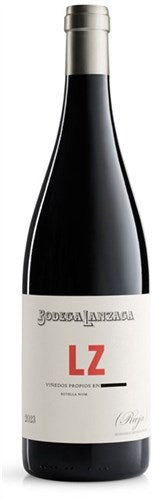
2022 Bodega Lanzaga, `LZ` Rioja - Liberty
- Regular price
- £21.48 GBP
- Regular price
-
- Sale price
- £21.48 GBP
- Unit price
- per
Couldn't load pickup availability
In the early 1990s, Telmo Rodríguez left his family estate in Rioja to make a name for himself in the rest of Spain. When he returned in 1998, founding Bodega Lanzaga with his friend Pablo Eguzkiza, he brought with him a broad experience from not only Spain but also Burgundy, Bordeaux (where he studied) and the Rhône.
Telmo returned to Rioja with a new perspective, determined to approach the region without the constraints of the Consejo Regulador. His rebellion is reflected in the labels of both `LZ` and `Lanzaga`, where, much to his distaste, Telmo was told by the Consejo Regulador that the village name ‘Lanciego’ could not be used on the label. Characteristically, he drew a black line across the name rather than remove it altogether, hoping that one day his Burgundian approach would be accepted by the authorities. Telmo’s knowledge of the history of Alavesa also informed his decision-making, as he knew that old vines had been planted on the hills surrounding the village of Lanciego for centuries. As a result, this village name can be viewed as an indication of origin and quality (similar to Burgundy), and this approach to site-specific winemaking is something that makes Bodega Lanzaga one of Rioja's most exciting producers.
Today, Bodega Lanzaga farms 25 hectares of organically managed vineyards around Lanciego, on a plateau at over 500 metres elevation. The 40 plots are surrounded by dry stone walls, with fruit trees planted among the vines to encourage biodiversity and revive traditional practices. ‘LZ’, their ‘regional wine’ in Burgundian terms, is made from Tempranillo, Graciano and Garnacha sourced from the vineyards that are close to the Lanzaga winery. After fermentation with indigenous yeasts, it ages in cement tanks for six to seven months before bottling. This lack of time in oak preserves the brightness of fruit, which is complemented by perfectly managed tannins.
The village wine, Lanzaga, is sourced from dozens of plots totalling 20 hectares around Lanciego. A selection of the best fruit is hand-harvested and fermented in cement tanks, before ageing in a combination of large and small oak barriques (up to 25hl) for up to 14 months. The result is a rich, complex, yet elegant wine that honestly reflects the nuances of the vineyard site.
Bodega Lanzaga have also selected four vineyards they deem to be exceptional, to create the single-vineyard Riojas. Two of them, ‘El Velado’ (mostly Garnacha and Tempranillo) and ‘La Estrada’ (Tempranillo with a dash of Graciano), are just north of Lanciego, higher up towards the mountains. They are both very small, with ‘El Velado’ being just under a hectare, while ‘La Estrada’ is less than half a hectare. Along with ‘Tabuerniga’ (Tempranillo and Graciano), which comprises 2.7 hectares of vines west of the village, towards ‘La Bastida’, these three are Lanzaga’s 1er Cru vineyards.
Bodega Lanzaga’s Grand Cru vineyard is ‘Las Beatas’, a remarkable site planted 600 metres above sea level, on the terraced hills of an amphitheatre west of Lanciego. Like all their vineyards, ‘Las Beatas’ is farmed organically and biodynamically. This wine frequently ranks among Spain’s finest, vindicating Pedro and Telmo’s decision to establish Bodega Lanzaga almost 30 years ago. All the wines from Bodega Lanzaga have reimagined the style of Rioja and cumulatively act as a beacon to other producers wishing to break free of the constraints of the Consejo Regulador.
`LZ` is made with Tempranillo, Graciano and Garnacha grapes from several estate plots (Campoluengo, Las Rozas, Castillejo, El Romeral, Agozaderas and El Plano) around the Lanciego village, in the Rioja Alavesa area. Here, the organic-certified bush vines grow at altitudes ranging from 450 to 650 meters above sea level on two main soil types. On the flat sandstone plateaus the vines grow on shallow, low fertility stony, calcareous and silty textured soils which inhibit vigour and concentrate the flavours, adding mineral notes. The soils on the gentle slopes are moderately deep, with less stone, a higher marl content and very fine texture which prolonges the ripening and adds freshness to the finished wine.
The 2022 vintage will be remembered for the heatwaves experienced throughout the spring and summer months, making it the earliest harvest in the winery's history. Plentiful rains throughout November and December enabled excellent water reserves for the vines to survive throughout the year and, despite the reduced yields, the resulting harvest was of excellent quality.
The grapes were handpicked and transported in small boxes to the winery where most of the fruit was destemmed. The three varieties were co-fermented with indigenous yeasts in small cement tanks where they remained for a further 6-7 months. The wine was fined and lightly filtered before bottling.
Medium purple in colour, this wine is made in a fresh, fruit-driven style. The lack of time in oak preserves the brightness of fruit, with ripe red cherry, redcurrant and plum, and a juicy and fleshy palate nicely defined by well managed tannins. The wine has a medium body, balanced by well-integrated acidity and a fine mineral touch.
Share